Models, surrogates, and expertise for hydro-gravitational hazards
PHYGRAV delivers integrated simulations, surrogate apps, and decision-ready products for landslides, avalanches, tsunamis, and hydro-sedimentary events. The platform merges advanced physics, digital twins, and uncertainty-aware workflows for partners across research, agencies, and operators.
AI-based solutions
AI-enhanced surrogates accelerate hazard scenarios and keep decision workflows responsive while preserving physics-grounded reliability.
Scenario acceleration
Machine-learned surrogates cut runtime for landslide and tsunami chains.
Decision support
AI pipelines turn simulations into alerts, dashboards, and actionable briefings.
Outputs & Products
Standardized exports (netCDF, maps, indicators) derived from surrogate training runs.
Platform Services
Access ready-to-run surrogates and deeper simulation stacks for bespoke studies. Each
service has a dedicated workspace under Apps/ or Simuls/.
Surrogate apps
Pre-trained surrogate services for rapid what-if exploration and decision workflows.
LandslideTsurrogate (Mayotte)
Operational surrogate delivering fast landslide-tsunami scenarios; tuned for Mayotte.
Shaltop Surrogate
Precomputed mass-drop simulations over complex topography; supports seismic add-ons.
Numerical models & data
Full-physics simulation stacks and reference outputs that feed and validate surrogates.
Landslide / Avalanche
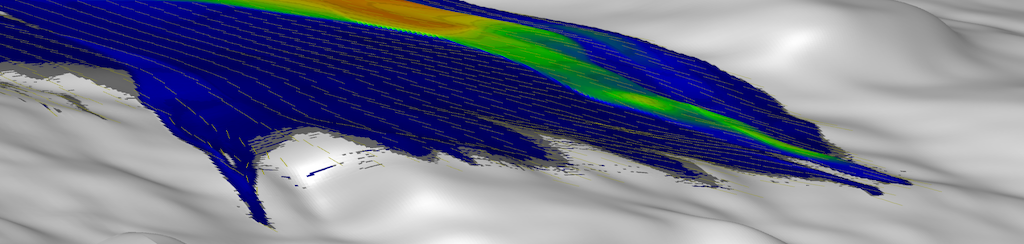
Physics-rich granular flow runs (model: Shaltop2d) feeding surrogates and reference products.
Tsunami
Numerical tsunami propagation and coastal impact studies using HySEA.
HydroSedim
Hydro-turbidity river scenarios and sediment response; built for mountain catchments.
Teams & Boards
Governance for scientific quality, operations, and external engagement.
Principal Investigator
Steers roadmap, partnerships, and validation of scientific deliverables.
Co-Investigators
Anne Mangeney · Anne Le Friant
Lead on hazard physics, tsunami modeling, and research integration.
Executive / Operations
Cléa Lumina Denamiel · Alexis Marboeuf · Antoine Lucas
Day-to-day service delivery, releases, and user onboarding.
Expertise Board
Kate Allstadt · François Bouchut · Cléa Lumina Denamiel · Anne Le Friant · Johan Gaume · Gilles Grandjean · Clément Hibert · Jiahui Kang · Clara Levy · Antoine Lucas · Anne Mangeney · Alexis Marboeuf · Marc Peruzzetto
Develops, maintains, and reviews models.