Surrogate methods
PHYGRAV builds surrogates from high-fidelity tsunami and granular flow simulations using generalized Polynomial Chaos Expansions (gPCE) and sparse quadrature. This page summarizes the workflow and highlights model-specific notes.
Surrogate pipeline
1) Inputs & sampling
Define stochastic inputs (e.g., slide volume, location) with independent priors. When data are sparse, uniform ranges follow the maximum-entropy principle.
2) gPCE basis
Represent hazards ξ on Legendre polynomial bases for uniform priors: ξ̂(R)=Σ_{|α|≤p} ξα Ψα(R).
3) PSA fitting
Compute coefficients via pseudo-spectral approximation (Smolyak sparse grids), limiting the number of full simulations while retaining accuracy.
4) Outputs & checks
Produce moments, sensitivities, and rapid scenario sweeps; validate against withheld simulations and publish standard outputs.
Models
Short summaries of the numerical cores used to generate training simulations.
Shaltop
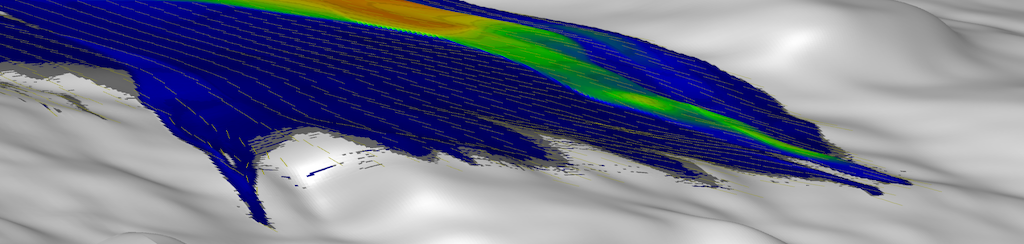
Depth-averaged Savage–Hutter (Saint-Venant type) model for granular and fluid flows over complex topography, with multiple friction laws (Coulomb, Bingham, viscous).
See Ressources/shaltop.tex for derivations, history, and validation cases.
LandslideTsurrogate
gPCE-based surrogate for landslide-generated tsunami hazards; calibrated on deterministic runs per zone with delayed Gauss–Patterson sampling.
Source LaTeX: Ressources/tsurrogate.tex; includes sampling design and PSA details.
HySea (placeholder)
Numerical tsunami propagation and coastal impact solver; section to be expanded with equations and sampling once the draft is added.